Family-owned slab leak detection and repair since 1976. Acoustic, thermal, and pressure detection — spot repair, reroute, epoxy lining, or repipe. Honest options for the right fix.
A slab leak is a leak in a supply or drain line that runs under the concrete foundation of your house. You can’t see it, you can’t walk to it, and it doesn’t stop on its own. The longer it goes undiagnosed, the more it costs — not just in the water bill, but in the saturated soil, lifted flooring, and slow damage to the foundation. Since 1976, AAA Paradise Plumbing & Rooter has been finding and fixing slab leaks across Ventura County, including the older tract neighborhoods where they’re most common.
We pinpoint the leak first — acoustic listening, thermal imaging, pressure testing — before we ever touch the slab. Then we walk you through the real repair options: spot repair, reroute, epoxy lining, or repipe. No pressure, no oversell. We tell you what makes sense for your home and your budget.
Signs You Have a Slab Leak
Slab leaks usually announce themselves through one or more of these signs. If you’re seeing more than one together, call as soon as you can:
Warm or hot spot on the floor. The single most reliable indicator of a hot-water slab leak. The escaping hot water warms the surrounding slab.
The sound of running water when every fixture in the house is shut off. The leak is moving water continuously even when nothing’s open.
Unexplained jump in your water bill. A 20%–50% increase with no change in household water use is a strong signal.
Mildew, musty smell, or damp carpet in an area of the house with no obvious water source.
Cracks in flooring, baseboards, or the slab itself. Long-term slab leaks saturate the soil under the foundation and can cause it to shift.
Water meter still spinning after every fixture and appliance in the house is off. Diagnostic gold — you have a supply-side leak somewhere.
Lower water pressure than you used to have, especially at fixtures closest to the leak.
Visible water seeping through baseboards, around the perimeter of the slab, or into walls along the floor line.
What Causes Slab Leaks
The plumbing under your slab isn’t supposed to fail in the first 50 years — but several common conditions accelerate it. In Ventura County, four causes account for almost every slab leak we see.
Pipe age and corrosion
Tract homes built in the 1950s through 1970s often used thin-wall copper or galvanized supply lines under the slab. Decades of use, water chemistry, and mineral content eat the pipe from the inside until it pinholes. Some neighborhoods see a wave of slab leaks as the original plumbing reaches end of life.
Soil shift and earth movement
Settling, minor seismic activity, and changing soil moisture can stress the rigid pipe under the slab. Joints fail at points of bending stress, and the pipe leaks.
Abrasion against the slab or rebar
Where the original installer didn’t insulate the pipe properly from the concrete or the steel rebar in the slab, decades of thermal expansion and contraction wear a thin spot into the copper. Eventually it pinholes.
Acidic water chemistry
Some Ventura County water sources are slightly acidic over time. Acidic water dissolves the inside of copper supply lines, thinning the pipe wall until it leaks. A whole-house filtration system can slow the corrosion on remaining lines.
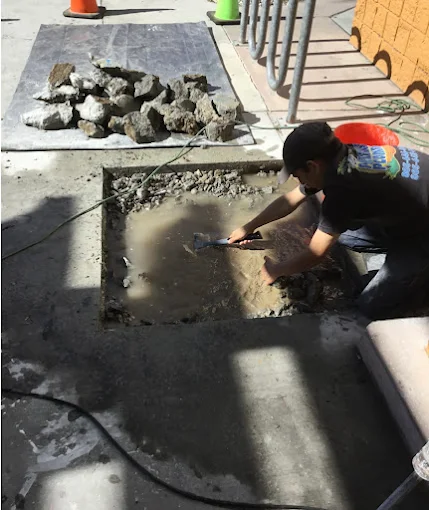
Slab leak access and repair — Ventura, CA.
How We Locate a Slab Leak
We don’t guess and we don’t open the slab until we’ve pinpointed exactly where the leak is. Four diagnostic tools in sequence:
Static pressure test
First step. We isolate the supply line, pressurize it, and watch the gauge. A dropping gauge confirms a supply-side leak; a holding gauge says the leak is somewhere else (drain side, irrigation tie-in, or fixture).
Acoustic listening
Pressurized water escaping through a pinhole under a slab makes a distinctive high-frequency sound. Specialized acoustic listening equipment amplifies that sound through the concrete. With the right gear and experience, we pinpoint the leak to within inches.
Thermal imaging
A hot-water slab leak warms the floor above it. A thermal imaging camera shows the temperature difference instantly, even through tile, carpet, or laminate. Especially powerful for confirming what acoustic detection found.
Tracer gas or line tracing
For trickier locations — or when the leak is on a section of line we can’t hear acoustically — we use tracer gas or line tracing equipment to confirm the exact path of the supply line and the leak point.
Repair Options Once We Find the Leak
The right fix depends on where the leak is, how old the rest of the plumbing is, what’s on top of the slab, and your long-term plans for the house. Four options to consider:
Spot repair (break through the slab)
We open a minimal section of slab directly above the leak, cut out the failed section of pipe, and install new copper or PEX. Repair the slab and finish. Best when the rest of the line is in good shape, the floor finish is replaceable, and the leak is isolated.
Reroute
Instead of breaking through the slab, we run a new supply line through the attic, an accessible wall, or the crawl space — bypassing the leaking section entirely. The old line is abandoned in place. Often cheaper than opening a slab with expensive flooring on top, and faster.
Epoxy pipe lining
For lines with multiple pinholes or recurring leaks, an epoxy lining coats the inside of the existing pipe with a thin, durable layer. The old pipe stays in place; the epoxy becomes the new water-bearing surface. Extends pipe life significantly without opening the slab. Best when multiple leaks are appearing on the same line.
Whole-house repipe
When the leak you found is the third or fourth on the same system — and the rest of the supply is the same age and material — a whole-house repipe is the right long-term answer. We typically run new lines through the attic and walls, abandoning the under-slab plumbing entirely. One job, no more chasing leaks.
Our Slab Leak Repair Process
Diagnose first, dig last. We talk through the symptoms, walk the house, check the meter, and run static pressure testing before we touch a tool.
Pinpoint with the right gear. Acoustic, thermal, and tracer methods narrow the leak to a specific point. We mark it on the floor.
Walk you through real options. Spot repair, reroute, epoxy lining, or repipe — with honest cost ranges and honest tradeoffs. Your call, not ours.
Upfront pricing, no surprises. You approve the price and the method before we open anything. We don’t add line items at the end.
Repair, test, document. We test the repair under full system pressure, document what we found and fixed (helpful if insurance is involved), and leave the work area clean.
Why Ventura County Homeowners Choose AAA Paradise for Slab Leaks
Family-owned since 1976. The dispatcher who picks up at 2 a.m. is not a call center in another time zone.
Licensed, bonded, insured. CA Contractor License #323929.
No travel fee. Ventura to Calabasas, Ojai to Goleta — we don’t bill you for the drive.
Right tools on every truck. Acoustic, thermal, tracer, pressure testing — not just one method.
Detection before destruction. We pinpoint first, then open only what we need.
Honest repair options. Spot repair, reroute, epoxy lining, repipe — the right one for your home, not the most expensive one.
Insurance documentation. Detailed reports and photos for the adjuster, no extra charge.
24/7 emergency response. Active slab leaks don’t wait for business hours.
Slab Leak FAQs
A few telltale signs: a warm or hot spot on your floor (hot-water slab leak), the sound of running water when nothing in the house is on, unexplained high water bills, mildew or musty smell coming from carpet or flooring, cracks in the slab or visible flooring, and your water meter still spinning after every fixture is shut off. Any one of these warrants a call. Two or more is almost certainly a slab leak.
No. Slab leaks always get worse, not better. The water keeps escaping, the surrounding soil saturates, the slab can shift, and damage to flooring, framing, and foundation accumulates the entire time. Even a small slab leak should be diagnosed and fixed promptly.
It depends entirely on the leak’s location, the repair method, and the condition of the rest of the plumbing. A spot repair through the slab is usually the least expensive. A reroute through the attic or wall can be cheaper than breaking through a finished slab. A whole-house repipe is the most expensive but the most permanent fix if the rest of the system is failing too. We pinpoint the leak first, then quote real repair options with honest cost ranges before any work begins.
Usually the water damage is covered but the failed pipe is not. Most policies pay for tearing out and replacing affected flooring, drywall, cabinets, and other water-damaged finishes, but the pipe repair itself is on the homeowner. We provide detailed reports and photo documentation that insurance adjusters need.
For the right situation, yes. Epoxy lining can extend the life of an existing under-slab line significantly without breaking through the slab. It’s a strong option when multiple pinhole leaks are appearing on the same line, when the slab is finished with expensive flooring, or when a reroute isn’t practical. It’s not the right answer when the line is fully collapsed or has severe damage. We’ll evaluate and recommend honestly.
Yes — 24 hours a day, every day. A real dispatcher answers the phone, gives you a real ETA, and routes the nearest crew. If you have an active slab leak with water actively running and you can’t find the shut-off, call right now. Call 805-642-9222.
I had an excellent experience with Paradise Plumbing. They responded quickly to my call and arrived right on time. The plumber was professional, clean, and worked efficiently to fix the issue without any hassle. Everything was completed faster than I expected, and they left the area spotless. I really appreciate their prompt service and attention to detail. Highly recommend them to anyone looking for reliable and efficient plumbing work!
Paradise Plumbing exceeded my expectations. From the fast response to the efficient repair, everything was handled with professionalism and care. The technician was courteous, worked quickly, and kept the work place clean throughout the job. It’s refreshing to find a company that values both quality work and great customer service. I wouldn’t hesitate to use them again or recommend them to others!
I had a great experience with Ruben Reza. He was very professional and easy to work with and I was able to schedule an appointment easily. The repairs were completed efficiently and they were very respectful of my home. I would highly recommend for any of my future plumbing needs.
I had a big pipe burst and called Paradise Plumbing at 7:30am and they were here by 9am. Luis was very nice and went right to work in the pouring rain. Thanks Luis!