Replace a failing sewer line without trenching your yard, driveway, or hardscape. Pipe bursting and CIPP lining by a family-owned Ventura County plumber since 1976. Sewer camera diagnosis, flat pricing, two-pit access instead of a 50-foot trench.
For most of plumbing history, replacing a sewer line meant the same thing it sounded like: dig a trench from your house to the street, take the old pipe out, put a new pipe in, fill the trench, and then spend weeks restoring the lawn, the driveway, the sidewalk, the patio, and the irrigation that got torn up in the process. Trenchless changed that. Today, the same sewer replacement can usually be done through two small access pits — one near the house, one near the city tap — with the new pipe pulled through the path of the old one and nothing in between disturbed. Since 1976, AAA Paradise Plumbing & Rooter has been doing sewer work in Ventura County; we’ve done it both ways, and trenchless is the right call for most modern jobs.
Two methods, both trenchless, both proven: pipe bursting and cured-in-place pipe (CIPP) lining. We diagnose with a sewer camera first and tell you honestly which one your specific situation calls for — or whether traditional excavation is actually the smarter answer.
The Two Trenchless Methods
Pipe bursting
A steel cable is pulled through the existing sewer line. Attached to the leading end is a bursting head — a cone-shaped tool that fractures the old pipe outward into the surrounding soil as it’s pulled. Connected to the trailing end is a new HDPE (high-density polyethylene) pipe that follows the bursting head into position. By the time the head emerges at the receiving pit, the old pipe is gone and the new pipe is in place. Used for full replacement when the old pipe is structurally compromised — collapsed sections, severe root damage, badly misaligned joints, or just end-of-life material like clay tile or Orangeburg.
Cured-in-place pipe lining (CIPP)
A flexible resin-saturated liner is pulled through the existing pipe, then inflated against the inside wall and cured (with heat, steam, UV, or ambient temperature) until it hardens into a structural new pipe inside the old one. The host pipe stays in place but no longer carries flow — the cured liner does. Used when the existing pipe is still structurally sound enough to support the liner during installation, but has cracks, joint separations, root intrusion at joints, or wall corrosion that needs sealing. Adds decades to the life of an otherwise failing line without removing it.
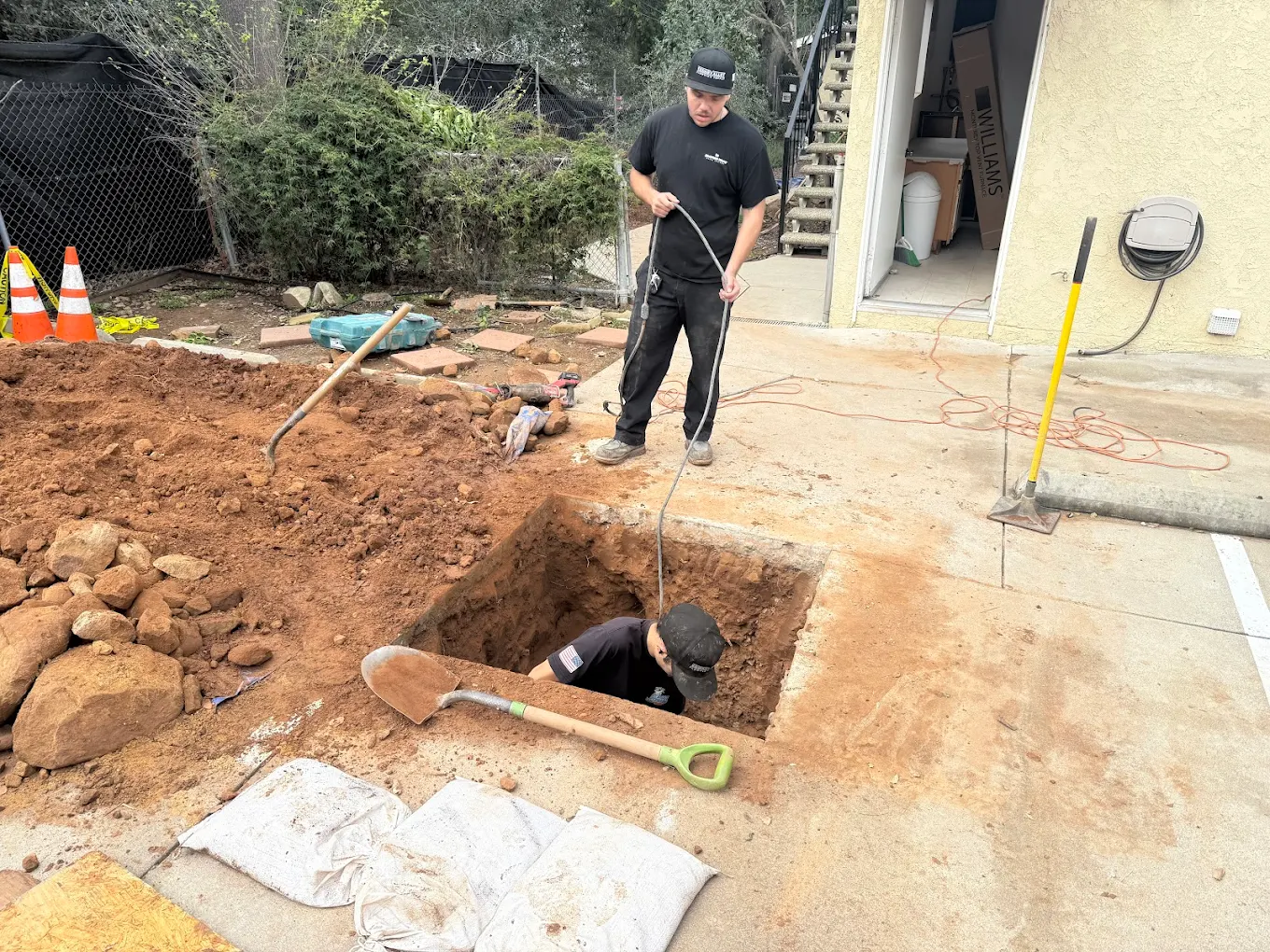
Feeding a pull cable into a trenchless access pit in Ventura, CA.
When Trenchless Is the Right Call
You have mature landscaping you don’t want torn up. Trees, shrubs, irrigation systems — a trench takes them all out. Trenchless leaves them intact.
The sewer runs under a driveway, sidewalk, or patio. Cutting through concrete and then re-pouring it is expensive. Trenchless avoids that entirely.
You’re in an HOA or condo complex. Less disruption, less mess, less time on site, less drama with neighbors and HOA boards.
The line is long. A 60-foot trench is significantly more invasive than a 30-foot one; trenchless cost scales more gracefully on long runs.
The line is deep. Deeper trenches require shoring and more excavation; trenchless depth doesn’t change the surface impact.
You want it done fast. Most trenchless jobs are one day on site. Most traditional sewer replacements are two to three plus a week of restoration.
When Traditional Trenching Is the Better Call
Not every sewer job is a trenchless candidate. Cases where open-cut excavation is the right move:
The line is severely collapsed or completely blocked — nothing to pull a cable through
The line has multiple sharp turns or junctions that trenchless can’t navigate
The line is shallow and in open dirt with no landscaping — trenchless cost premium doesn’t pay off
Multiple lines need to be replaced at once and combined trenching is cheaper
The line failed in a spot where a single-point spot repair makes more sense than a full replacement
We’ll always tell you when traditional is the smarter call. We do both. Whatever’s right for your situation is what we recommend.
Why Sewer Lines Fail in Ventura County
Old clay tile and Orangeburg pipe
Homes built before about 1980 often have sewer laterals made of vitrified clay tile (jointed in short sections every 2-3 feet) or Orangeburg (a tar-impregnated wood-fiber pipe). Both have known end-of-life behavior — clay joints separate and admit roots; Orangeburg deforms and collapses. Across whole Ventura County neighborhoods of similar construction era, we see waves of these failures as homes hit the same age window.
Tree root intrusion
Ficus, eucalyptus, palm, and pepper trees all push aggressive roots toward sewer joints. Roots find the smallest seam, push in, and over time crack the pipe wide open. Hydro-jetting can clear the roots short-term; trenchless replacement fixes the underlying broken pipe.
Soil movement and settlement
Ventura County’s clay-rich, expansive soil expands and contracts seasonally. Combined with periodic seismic activity, it puts steady stress on buried sewer lines. Joint separations, sagging sections (bellies that hold standing water and waste), and cracked pipe walls are all common.
Cast iron corrosion
Homes from the 1950s-1970s often used cast iron for the indoor and near-house portions of the sewer. Cast iron rusts from the inside out; once the wall thins enough, it cracks, scales, or collapses. The portion under the house is usually accessible through the slab or crawlspace; the portion out to the city tap is usually the trenchless candidate.
Our Trenchless Sewer Replacement Process
Sewer camera inspection. Before we recommend anything, we put a camera down the line and look at exactly what’s going on. Cracks, breaks, bellies, root intrusion, separated joints — documented with video. You see the same footage we see.
Diagnose and recommend. Based on what the camera shows, we tell you whether trenchless (and which method) or traditional is right for your specific line. Both options priced, both options explained.
Pull permits. Sewer lateral work in Ventura County requires a permit. We pull it, coordinate with the city or county, and meet inspectors on site as needed.
Locate utilities. Before any digging, we call DigAlert (USA North 811) and have all underground utilities located and marked.
Dig access pits. Two pits, typically about 3x4 feet each — one near the house cleanout, one near the city tap or property line. That’s the only disturbance to the yard.
Run the trenchless method. Pipe bursting: pull the new HDPE pipe through while fracturing the old one. CIPP: pull the liner through, inflate, cure. Either way, the new pipe ends up in place between the two pits.
Reconnect. Tie the new pipe into the cleanout at the house side and the city tap at the street side. Test the connections.
Camera-verify. Re-camera the line after install to confirm it’s clean, properly aligned, and flowing correctly. You see this footage too.
Backfill and patch. Fill the access pits, restore the surface. Cement patches where concrete was cut, sod or soil where dirt was opened.
Final inspection. Meet the inspector for the city/county sign-off. Workmanship warranty and manufacturer warranty paperwork goes to you in writing.
Trenchless vs Traditional: The Real Cost Comparison
People assume trenchless is more expensive than traditional dig. Per linear foot of pipe, that’s usually true — the equipment is specialized and the materials cost more. But sewer replacement total cost isn’t just the pipe. It’s:
The pipe and labor (where trenchless has a small premium)
Plus the trench excavation (much smaller with trenchless)
Plus the landscape restoration — sod, irrigation repair, replanting (much smaller with trenchless)
Plus hardscape restoration — cut concrete, re-pouring driveways/sidewalks/patios (often zero with trenchless)
Plus the inconvenience of having your yard or driveway out of commission for a week or more
Once you add it all up, trenchless is often the cheaper total project — especially when there’s any concrete, mature landscaping, or HOA-approved hardscape in the way. We’ll quote both options when both are viable so you can compare the real numbers, not just the per-foot pipe cost.
What HDPE Pipe and CIPP Liner Get You
50-100 year design life on HDPE pipe — significantly longer than the clay, cast iron, or Orangeburg they replace
Seamless construction — HDPE is fused at joints into a continuous run with no separations for roots to invade
Root resistant — both HDPE and CIPP liner present a smooth, jointless surface that roots can’t penetrate
Corrosion proof — doesn’t rust like cast iron, doesn’t deteriorate like Orangeburg
Smooth interior — flows better than rough-walled clay or scaled cast iron, reduces future clogs
Manufacturer warranty — multi-decade warranties on both HDPE pipe and CIPP liners, passed through to you in writing
Why Ventura County Homeowners Choose AAA Paradise
Family-owned since 1976. We’ve been doing sewer work in Ventura County since before trenchless existed — and we adopted it when it proved itself.
We do both. Trenchless when it’s right, traditional when it isn’t. We’re not selling a one-size-fits-all method.
Sewer camera diagnosis included. No recommendation without a real look at what’s actually wrong.
Licensed, bonded, insured. CA Contractor License #323929.
Permits pulled, inspections coordinated. We handle the paperwork.
Flat pricing up front. Both options quoted in writing when both apply. No hourly creep.
No travel fee. Ventura to Calabasas, Ojai to Goleta.
Warrantied workmanship. Written into every work order. Manufacturer warranties on pipe and liner pass through to you.
Trenchless Sewer Replacement FAQs
Trenchless sewer replacement means replacing or rehabilitating your sewer line without digging a continuous trench from house to street. We use two main methods. Pipe bursting pulls a new HDPE pipe through the path of the old one while a bursting head fractures the old pipe outward into the surrounding soil. CIPP lining (cured-in-place pipe) pulls a resin-saturated liner through the existing pipe and cures it into a structural new pipe inside the old one. Both methods need only two small access pits — one at each end of the run — instead of trenching the entire length.
Most are. Pipe bursting works for sewer lines made of clay, cast iron, ABS, or PVC, as long as the surrounding soil will accept the burst. CIPP lining works when the existing pipe is structurally sound enough to host the liner — collapsed sections or major misalignments may need to be open-cut. We diagnose with a sewer camera first and tell you honestly which method (if any) makes sense for your specific situation. Sometimes traditional trenching is still the right answer, and we’ll say so.
Trenchless is priced by linear foot, with adjustments for access pit complexity, depth, and any obstacles in the run. Per-foot, trenchless usually costs a bit more than open-trench excavation in raw materials and labor — but once you add the cost of restoring trenched landscaping, driveways, sidewalks, and hardscape, trenchless is often the cheaper total project. We diagnose first and give you a flat price up front, with line items for both options when both are viable so you can compare apples to apples.
Most residential trenchless sewer replacements are a one-day job. Larger runs, deeper lines, or lines with complex bends can stretch to two days. Compare that to traditional trenching, which often takes two to three days plus an additional week or more for landscape and hardscape restoration. Less yard disruption, faster return to normal.
Minimally. We need two access pits — one near the house, one near the city tap or cleanout — typically about 3x4 feet each. Everything between them stays intact: grass, shrubs, hardscape, driveways, sidewalks. Compared to trenching, which opens up the entire run from house to street, trenchless keeps mature trees, landscape design, and concrete work untouched. The two access pits get filled and patched once the work is done.
HDPE pipe (used in pipe bursting) has a 50-100 year design life and is virtually impervious to root intrusion and corrosion. CIPP liners are typically rated for 50 years. Both significantly outlast the clay, cast iron, or Orangeburg sewer lines they usually replace — most of which had service lives of 50-60 years and are well past that when we get to them. Our workmanship warranty plus the manufacturer warranties on the pipe and liner are all spelled out in writing on the work order.
Outstanding service! AAA Paradise Plumbing installed a whole house filtration system and re-piped my home. Knowledgeable, efficient, quality workmanship and very clean. I highly recommend this company!
I had a few other companies out and nobody could figure out/solve the issue I was having with my drains. Called Paradise Plumbing and they were out within one hour. Jeremy and Henry explained to me what needed to be done and within 2 hours my problems were solved. Extremely knowledgeable!!!! I would recommend these plumbers to anyone! Thank you Team Paradise!!
We have used AAA Paradise Plumbing for a few jobs now and won’t ever use another plumbing company. Everyone we have worked with has been fantastic. David has been the main guy we’ve seen. They explain things in detail, without making you feel dumb for not understanding plumbing. Thank you for everything!
Richard was fantastic. He’s provided service before, and I knew when I got the message as to who was coming, I would have my problem handled efficiently and professionally. Top notch