Couldn’t be more satisfied, on time, courteous and highly professional, Plumber Jeff was awesome....will not hesitate to call for their services when a problem arises.
Mickey Metcalf
Google Review
Family-owned leak detection since 1976. Electronic detection, thermal imaging, acoustic listening, and video inspection — find the leak without tearing up the house.
A hidden water leak is the most expensive problem in plumbing — not because the repair is costly, but because every day it goes undiagnosed is another day of damage to the house. A pinhole leak under a slab can swell flooring, rot framing, and feed mold for months before you ever see the bill. Since 1976, AAA Paradise Plumbing & Rooter has been finding hidden leaks across Ventura County the way they should be found: with the right equipment, in the right sequence, with the smallest possible opening.
We carry electronic leak detection equipment, thermal imaging cameras, acoustic listening gear, and sewer-line video inspection on every leak call. The goal is always the same — pinpoint the leak before we ever cut into the wall, the floor, or the slab.
Most hidden leaks announce themselves in subtle ways before they become a flood. If you’re seeing one or more of these, it’s time to schedule detection:
The leak almost always shows up somewhere other than its source. Knowing the common hiding spots tells us where to start looking.
Older Ventura tract homes with copper supply lines run under the slab are prone to pinhole leaks. The first sign is usually a warm spot on the floor (hot-side leak) or a high water bill with no visible water (cold-side). Acoustic detection and thermal imaging pinpoint the exact location so we open only the area we need to.
A leaking fitting in a wall cavity is a slow drip that you may not see for weeks. By the time the paint discolors or the drywall softens, the inside of the wall is already compromised. We use moisture meters and thermal imaging through the drywall before opening anything.
The main supply line from the meter to the house runs underground — sometimes 50 to 100 feet. Old galvanized or polybutylene lines fail at fittings. We can locate the line, isolate sections with pressure testing, and pinpoint the leak before we excavate.
Toilet flanges, shower pans, tub overflows, and supply stops are constant suspects. A small leak at a supply stop can wet a subfloor for years before it shows up as a downstairs ceiling stain.
A leaking T&P valve, a corroded tank fitting, or a slow drip from the connections is often dismissed as condensation until it isn’t. We check the unit and its supply lines as part of any whole-house leak diagnosis.
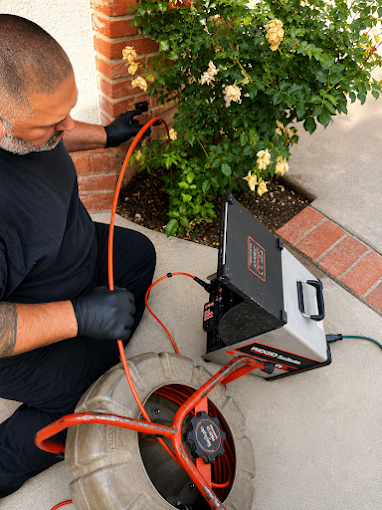
No single tool catches every leak. We carry several, and we use them in sequence:
The first step. We isolate the supply line, pressurize it, and watch the gauge. If pressure drops, the leak is on the supply side. If it holds, the leak is on the drain side or beyond the section we tested. This tells us which line to listen on.
Pressurized water escaping a pinhole makes a distinctive high-frequency sound. Acoustic listening gear amplifies that sound through walls, floors, and slabs. With practiced ears and the right equipment, we can pinpoint a leak to within inches.
A hot-water leak warms the surrounding floor or wall. A cold-water leak cools it. Thermal cameras show the temperature difference instantly, even through paint and tile. Especially powerful for slab leaks.
For pressure-side leaks where acoustic listening isn’t enough — very small pinholes, leaks in noisy environments — we use electronic leak detection equipment that picks up the high-frequency signature of pressurized water escape.
For drain-side leaks, we send a fiber-optic camera down the line. Cracks, separated joints, root intrusion, and breaks all show up clearly on the monitor — and the inspection includes precise measurement of how far down the line the problem is.
Detection isn’t the end of the job — it’s the start of fixing it. Depending on what we find, the repair takes one of these forms:
For an isolated leak on an otherwise sound line, we open the minimum access we need, cut out the failed section, and replace it. Cleanest, fastest, lowest cost when the rest of the line is in good shape.
When a leak is in a hard-to-access location — deep under a slab, embedded in a wall — rerouting a new line through the attic, an accessible wall, or the crawl space is often cheaper than opening a slab. The old line is abandoned in place; the new line takes over.
If the failed line is one of many leaks on an aging system (galvanized, polybutylene, original copper in a 1960s tract home), a full repipe is the right long-term answer. We’ll show you the diagnostic findings and quote both repair and repipe so you can decide.
For leaks where insurance is involved, we provide detailed reports and photo documentation that adjusters need. Insurance typically covers the damage from the water (drywall, flooring, cabinets) but not the failed pipe itself.
A few telltale signs: an unexplained jump in your water bill, the sound of running water when nothing is on, a warm spot on the floor, mildew or paint discoloration on a wall or ceiling, or your water meter still spinning after every fixture in the house is shut off. Any one of these on its own is worth a call. Two or more together almost guarantees a hidden leak.
It depends on the home’s age and construction. Older Ventura County homes with galvanized supply lines fail at the threaded joints as the pipe corrodes from the inside. Newer homes with copper supply lines can develop pinhole leaks from acidic water or movement. Slab homes can leak from supply or drain lines under the foundation. Outdoor irrigation tie-ins and old hose-bib stub-outs are also frequent culprits.
We use non-destructive detection methods first: a static pressure test isolates which line is leaking, acoustic listening equipment picks up the sound of water escaping under pressure, thermal imaging finds temperature differences from a hot or cold water leak, and a video camera goes inside drain lines to find cracks or breaks. Only after we’ve pinpointed the leak do we open the wall, floor, or slab — and we only open exactly what we need to access the repair.
It varies with how hidden the leak is. A leak under a sink we can see takes minutes. A slab leak that needs pressure testing, acoustic listening, and thermal imaging takes longer. We give you a flat price for the detection up front — no open-ended hourly bill — and you only pay for the detection. The repair is quoted separately, and you approve it before any work begins.
Typically the water damage is covered, but the failed pipe itself is not. Most policies pay for tearing up the floor or wall to access the leak and for repairing the damage caused by the water — drywall, flooring, cabinets — but the pipe replacement is on the homeowner. We provide detailed reports and photo documentation that insurance adjusters need.
Yes — 24 hours a day, every day. A real dispatcher answers, gives you a real ETA, and routes the nearest crew. If water is actively running and you can’t find the shut-off, that’s a stop-what-you-are-doing call. Call 805-642-9222.
Real dispatchers, day or night.
Couldn’t be more satisfied, on time, courteous and highly professional, Plumber Jeff was awesome....will not hesitate to call for their services when a problem arises.
I really can’t say enough good things about this company. Jeremy and Henry came out and assessed the job, provided me with solutions and completed the job with great professionalism and courtesy. Thank you Paradise Plumbing!
This business really impressed me. They were super professional and made everything easy from start to finish. The staff was friendly and really cared about getting things right. I’d definitely choose them again and recommend them to others!
Jeremy and Richard were responsive, professional, affordable, and timely. They were easy to work with and communicated well throughout the project. I had them replace my sewer lateral line and they got on the job quickly, neatly, and thoroughly. I was very impressed with their knowledge, professionalism and communication throughout. Highly recommend!!!!!!
Excellent service! The plumber arrived promptly, fixed the issue quickly and was very professional throughout. Highly recommend their services.

Family-owned Ventura County plumbing since 1976. A real dispatcher answers, day or night.
Family-owned plumbing across Ventura, Santa Barbara, and Los Angeles counties since 1976.
Don’t see your city? Call 805-642-9222 — we may still cover you.