Softeners for hard water, carbon filters for chlorine, sediment filters for grit. Treat every drop at the point of entry by a family-owned Ventura County plumber since 1976. Upfront pricing, no travel fee, ongoing maintenance support.
If you live in Ventura County, you already know the water is hard. You see it as white scale on the shower glass that returns the day after you scrub it off. You see it as spots on the dishes the dishwasher just ran. You feel it in soap that won’t lather, hair that won’t rinse clean, and skin that feels tight after a shower. You hear it in the water heater that’s noisier than it used to be and lasts a few years less than the manufacturer claimed. Whole-house filtration is the fix for all of it — one system installed at the point where water enters your home, treating every drop before it reaches a fixture, an appliance, or a glass. Since 1976, AAA Paradise Plumbing & Rooter has been installing, servicing, and maintaining whole-house systems across Ventura County.
There’s no single "whole-house filter" — the right system depends on what’s in your water and what you want out of it. We test, ask, and recommend. No upsell pressure on equipment you don’t need.
The Three Main Filtration Types
Most whole-house systems are built around one or more of these. Multi-stage systems combine all three; standalone units do one job well.
Water softening (ion exchange)
The most common Ventura County installation. A tank of resin beads coated with sodium ions; as hard water flows through, calcium and magnesium swap places with the sodium. The water that exits is "soft" — no more scale, no more soap lather problems. Periodically the resin is recharged with a salt brine from a separate tank. This is what people usually mean when they say "water softener." Most effective at solving the actual hard-water symptoms (scale, dry skin, soap waste) you notice every day.
Carbon filtration
Activated carbon media traps chlorine, chloramine, volatile organic compounds, and the chemistry behind off-tastes and odors. Municipal water in Ventura County is treated with chlorine or chloramine for safety; carbon filtration removes the residual after the water enters your home. Improves taste at every tap, removes the chlorine you’d otherwise breathe in shower steam, and protects rubber gaskets and seals that chlorine eventually degrades.
Sediment filtration
A mechanical filter (pleated cartridge or media bed) that catches physical particles — rust flakes from aging municipal mains, sand, silt, mineral debris. Usually the first stage in a multi-stage system because it protects the softener resin and carbon media downstream from getting fouled by grit. Cartridges get changed periodically (every 3-6 months for most installs).
Salt-free conditioning
An alternative to traditional softening that doesn’t use sodium exchange. Instead, it uses a template-assisted crystallization (TAC) process to alter how hardness minerals behave so they don’t bond to surfaces as scale. Doesn’t actually remove the hardness, but reduces the symptoms. Good fit when sodium is a strict dietary concern or when wastewater regulations restrict softener discharge. Less effective than true softening at solving the lather/skin/laundry problems.
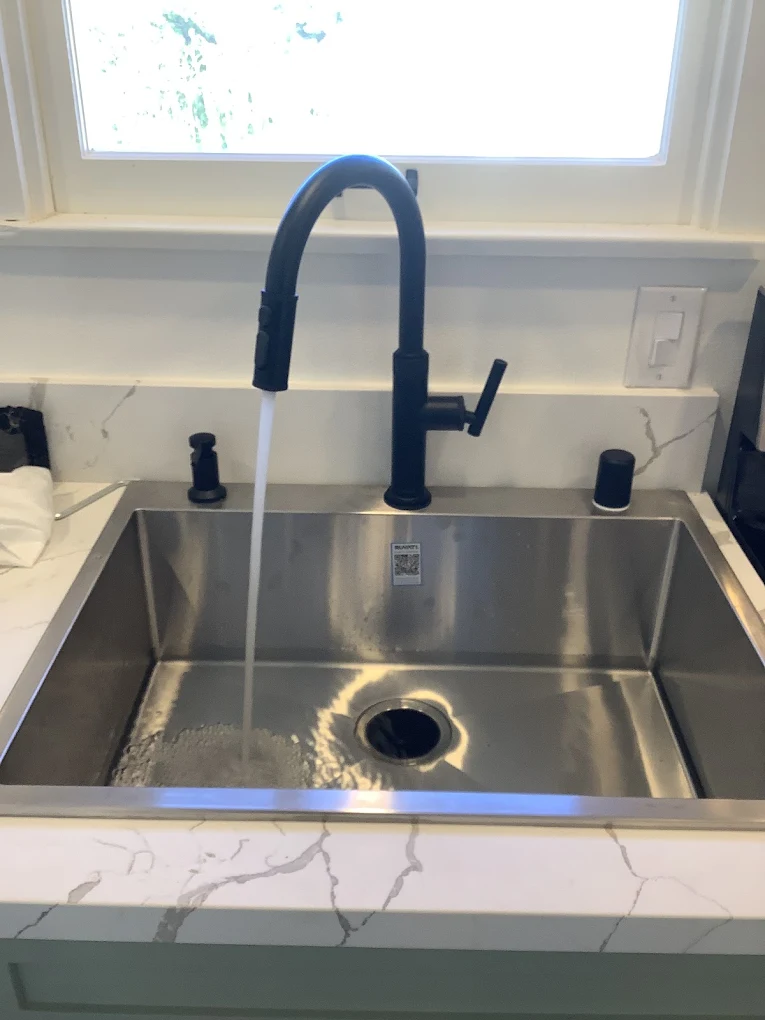
Clean, filtered water at every tap in the house.
Why Ventura County Water Needs Help
Hard water (very hard, actually)
Ventura County water averages 15-25 grains per gallon of hardness depending on the source — firmly in the "hard" to "very hard" range. That hardness is dissolved calcium and magnesium, which precipitates out as white scale anywhere water sits, evaporates, or gets heated. Over years, it narrows pipes, coats heating elements, clogs aerators, fogs shower glass, and shortens the life of every appliance that handles water.
Chlorine and chloramine
Municipal treatment uses chlorine or chloramine as a disinfectant residual all the way to your tap. That’s what keeps the water safe in the distribution system, but it means you’re drinking, cooking with, and showering in chlorinated water unless you filter it out at home. Carbon filtration handles it.
Aging municipal infrastructure
The pipes that bring water from the treatment plant to your house are decades old in most of Ventura County. Sediment, rust flakes, and mineral debris are common in the water that emerges from your tap — especially after main breaks, hydrant flushing, or system pressure changes. A sediment pre-filter catches it before it reaches your appliances.
What hard water costs you
Water heater life — scale buildup on the heating element or burner area can cut tank life from 12+ years to 6-8
Dishwasher and washing machine life — scale damages internal valves, pumps, and heating elements
Soap and detergent — hard water needs significantly more soap to lather; soft water cuts laundry detergent use 50%+
Hot water energy — scale on the heating element is an insulator; a scaled water heater uses more energy to deliver the same hot water
Plumbing — faucet aerators, shower heads, supply lines, fixture cartridges all wear faster with hard water passing through them
Cleaning time — you spend more time scrubbing scale off everything water touches
Whole-House vs Point-of-Use Filtration
Two completely different approaches:
Whole-house (point-of-entry)
Installed where the water main enters the house, usually near the water heater or in the garage. Every fixture, every appliance, every drop in the house gets treated. One system, one set of maintenance tasks. The right approach for hard water, chlorine, and sediment — problems that affect the whole plumbing system, not just drinking water.
Point-of-use (under-sink or fridge)
A small filter installed at one specific tap — usually the kitchen sink or refrigerator. Only treats water from that one outlet. Good for adding extra drinking-water filtration (reverse osmosis for bottled-water-quality drinking water) on top of a whole-house system. Doesn’t help with scale, doesn’t help with shower chlorine, doesn’t protect appliances.
Most Ventura County homes benefit from whole-house filtration as the foundation, with a point-of-use RO unit at the kitchen sink for premium drinking water. Different jobs; both are real.
Systems We Install
Whole-house water softeners. Salt-based ion exchange softeners sized to your home and water usage.
Carbon filtration systems. Catalytic carbon for chloramine, standard activated carbon for chlorine and taste/odor.
Sediment pre-filters. Cartridge or media-based sediment removal as a first stage.
Multi-stage combo systems. Sediment + carbon + softener in one integrated installation — the most common Ventura County setup.
Salt-free conditioners. For homes where traditional softening isn’t a fit.
Reverse osmosis drinking water systems. Under-sink units that deliver bottled-water-quality drinking water at the kitchen tap, often paired with a whole-house system.
UV sterilization. For homes on well water that need bacterial protection.
System replacements and upgrades. Old softener leaking or out of resin? Existing system not keeping up? We replace and upgrade too.
Our Filtration Install Process
Water test and consultation. We test your water for hardness, chlorine, sediment, and pH — on site. We ask what’s bothering you (scale, taste, smell, skin, appliances). The recommendation is based on real data, not assumptions.
System sizing. Right-sized for your household water usage. An oversized softener wastes salt and water on regen; an undersized one runs out before the next cycle.
Quote in writing. Flat price for the system, install, and any plumbing changes needed. No surprises.
Install at the point of entry. Usually near the water heater or in the garage. We tie into the main supply, install bypass valves, run the drain line for softener regen, and connect electrical if required.
Commission and program. Set the regen schedule, charge the salt tank, run the first cycle, test the output water to confirm the system is working as designed.
Walk you through it. Show you how to add salt, where the bypass is, how to check filter status, and what to call about. No mystery hardware.
Warranty in writing. Our workmanship warranty plus manufacturer warranties on the equipment, all on the work order.
Maintenance: What These Systems Need
Softener salt — refill every 1-2 months depending on household size and water hardness. A 40-50 lb bag at a time.
Sediment pre-filter cartridges — change every 3-6 months. Easy DIY or we’ll come do it.
Carbon media — lasts 5-7 years before replacement, depending on water volume and chlorine load.
Softener resin — lasts 10-15 years before declining capacity becomes noticeable.
System sanitization — periodic for systems that sit unused for extended periods.
We can put you on a regular maintenance schedule or just be the call when something needs attention. Your choice.
Why Ventura County Homeowners Choose AAA Paradise
Family-owned since 1976.
We test before we recommend. No selling you a system you don’t need. No selling you a too-small system to hit a price point.
Licensed, bonded, insured. CA Contractor License #323929.
No travel fee. Ventura to Calabasas, Ojai to Goleta — we don’t bill you for the drive.
Upfront pricing. Flat price for the system and install before we start.
Multiple brands. We’re not tied to one manufacturer. The right system for your situation is what we install.
Ongoing maintenance support. Filter changes, salt deliveries, system check-ups — one call.
Warranty in writing. Workmanship plus manufacturer, spelled out on the work order.
Whole House Filtration FAQs
Yes, significantly. Ventura County water averages around 15-25 grains per gallon of hardness, depending on the source — that’s firmly in the "hard" to "very hard" range. You see it as white scale on fixtures and shower glass, soap that won’t lather, dishwasher spots, and shortened life on every appliance that heats water. Softening is the most popular reason homeowners here install whole-house filtration.
Different problems, different solutions. A softener uses ion exchange to remove calcium and magnesium hardness — that’s specifically what causes scale and dry skin. A filter uses media (carbon, sediment, KDF) to remove things like chlorine, chloramine, sediment, taste, and odor. Most Ventura County homes benefit from both, which is why we usually install combined multi-stage systems rather than one or the other.
A fridge filter only treats the water that comes out of one tap. Hard water still scales your water heater, your dishwasher, your washing machine, every faucet aerator, every shower head, and every supply line in the house. Chlorine still vaporizes in your shower for you to breathe. Whole-house filtration treats water at the point of entry so every fixture, every appliance, and every drop benefits.
It depends entirely on which problems you’re solving and what size system your home needs. A standalone softener is the smallest project; a multi-stage system with softening, carbon filtration, and sediment pre-filter is the most involved. We test your water, ask about what’s bothering you (scale, taste, smell, dry skin), and quote a flat price for the right system before you commit. Upfront pricing, no surprises.
Softeners need salt added every 1-2 months depending on usage. Sediment pre-filters get changed every 3-6 months. Carbon filter media lasts 5-7 years depending on water volume and chlorine load. Resin in a softener lasts 10-15 years. We can set you up on a maintenance schedule or just be the call when something needs attention — your choice.
No, not in any noticeable way. Salt-based ion exchange softeners use sodium to swap out calcium and magnesium, so softened water contains very small amounts of added sodium — typically less than what’s in a slice of bread per glass. Most people can’t taste it. If sodium is a strict dietary concern, we can install salt-free conditioning systems instead, which use a different mechanism.
Richard did a fantastic job fixing a failing kitchen faucet in an efficient and cost-effective manner. He explained the problem and options to me, as well as options to save money on a new fixture. He was very thorough and careful in his work and was very professional. I would highly recommend him. The problem was really urgent and the response time was really quick on a Saturday morning.
I had my water heater replaced today by Paradise Plumbing. Henry was my Plumbing Technician. Henry was on time, extremely polite, very informative, maintained proper social distancing and wore a mask. Henry did an excellent job, he kept everything clean and I can tell he takes pride in his work and the company he works for. I highly recommend Paradise Plumbing!
Fantastic service starting from the moment I called in for service. Office staff was amazing and the plumber was out within 1 hour. This company really knows their stuff! I will refer AAA Paradise Plumbing and Rooter to all my friends and family.
Paradise Plumbing provided fast same day service. Technician David was very nice and kept in touch with me on the services I needed. I was using the other highly advertised plumber on TV but Paradise is now going to be my plumber of choice!
Beginning to end, my experience with Paradise Plumbing was pleasant, efficient and same-day. I appreciated the ease of making an appointment, that the service person changed to arrive earlier. The whole process (clogged pipe in kitchen) took less than 1/2 hour.